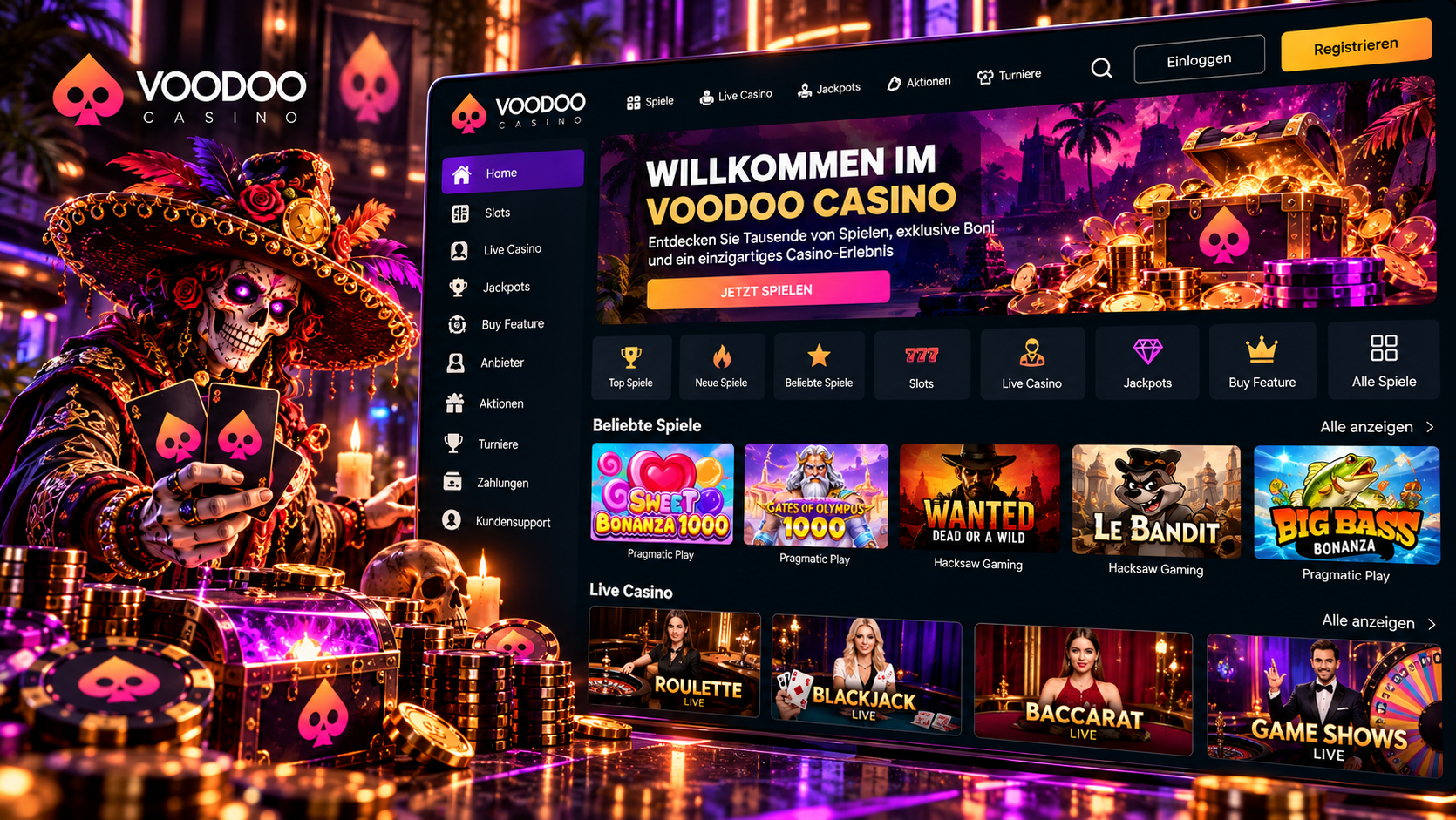
Finding your way around a large online casino is often less about the number of games and more about how those games are organized. Voodoo’s German platform takes a catalogue-first approach, combining broad game categories, provider filters, promotional areas, and dedicated sections into one interface. The online voodoo homepage provides a useful entry point into that structure.
The current German homepage presents a large selection of casino content alongside promotional features and multiple ways to narrow the catalogue. Rather than forcing visitors into a single browsing path, the interface provides several starting points depending on whether someone is looking for a particular provider, a newly added title, a popular game, or a specific type of casino content.
A Homepage Designed Around Discovery
The first impression of the platform is strongly catalogue-oriented. The navigation separates the main gaming areas into Slots, Live Casino, Jackpot Games, Buy Feature, Recommended, Hot, All Games, and Popular.
This structure matters because each section answers a different browsing question. Someone interested in live games does not need to search through slot titles, while visitors looking for newly highlighted content can use the platform’s dedicated discovery areas.
The homepage therefore functions as more than a simple landing page. It acts as a navigation layer for the wider casino library.
Thousands of Games Across Multiple Providers
Voodoo currently describes its catalogue as containing more than 4,000 premium games, while the provider directory displays collections from numerous studios. The German homepage currently shows providers including 1spin4win, Betsoft, BGaming, Booming Games, Evolution, Evoplay Entertainment, Hacksaw Gaming, NetEnt, Pragmatic Play, Spinomenal, and many others.
The exact number attached to an individual provider can change as the catalogue is updated. For example, the homepage currently displays 224 titles for 1spin4win, 255 for Hacksaw Gaming, and 702 for Spinomenal.
This provider-based structure gives the larger catalogue a useful hierarchy.
Provider Filters Make Large Libraries Easier to Navigate
Provider navigation is particularly helpful when visitors already have a preferred studio in mind.
Instead of scrolling through every available game, a visitor can select a provider and view its associated catalogue. Voodoo’s separate provider directory reinforces this approach, presenting provider names alongside their current game counts.
This also creates a more direct route for discovering related titles. Finding one game from a particular studio can naturally lead to exploring other releases from the same provider.
New Games Keep the Homepage Moving
A large casino interface needs a way to highlight recently added content, otherwise a constantly expanding catalogue can become difficult to follow.
Voodoo’s German new-games section currently lists more than 3,300 titles and marks individual releases with a “new” label. Current examples include Coins’n Diamonds Fortune from 1spin4win, Fist of Destruction Megamultiplier from Hacksaw, and several releases from other providers.
This creates a separate discovery route from the main provider catalogue. Visitors can either explore by studio or focus specifically on newer additions.
Popular and Recommended Content Provide Another Route
The homepage also contains dedicated areas for popular and recommended games. Individual game cards can carry labels such as “new” and “top,” while demo buttons are visible on many titles.
This means the same game can potentially be discovered through several different paths. A visitor might encounter a title through a provider page, a new-games section, a recommendation, or a popular-games category.
Such overlapping navigation is useful on a large platform because not every visitor approaches a catalogue with the same search strategy.
Demo Access Is Visible at the Catalogue Level
Another noticeable element is the presence of demo buttons on many game cards. These buttons appear directly alongside titles rather than being hidden behind a separate information page.
From a usability perspective, that gives visitors an immediate indication that a demo option is available for the relevant title. It also makes scanning the catalogue more informative because the game card communicates more than just its name.
The availability of a demo does not determine the outcome of a game, but it can make the browsing process more convenient for visitors who want to inspect titles before considering real-money play.
Promotions Sit Alongside the Catalogue
The German homepage does not separate promotional content entirely from game discovery. Current promotional areas include a welcome package, weekly cashback, a crypto deposit promotion, and a Friday Bonus, while additional campaigns and lotteries are also displayed.
Because promotional terms can change, these offers should be treated as current website information rather than permanent features. The dedicated promotions page provides the more appropriate place to examine the applicable conditions for any individual offer.
This separation between promotional headlines and detailed terms is important when evaluating casino offers.
Multiple Languages Add Another Navigation Layer
The German homepage also provides access to several language versions. The current interface identifies German as the active language and provides links for English, English-Australia, Italian, Norwegian, English-Canada, and French-Canada.
For an international platform, language selection is part of the overall user experience. It allows visitors to navigate the same broader ecosystem through different localized interfaces.
A Catalogue That Changes Continuously
One of the defining characteristics of an online casino catalogue is that it is not static.
Provider counts change, new releases are added, promotional campaigns rotate, and games can move between categories such as new, popular, recommended, or top. The current Voodoo homepage illustrates this clearly, with numerous titles carrying different status labels at the same time.
For that reason, catalogue figures should always be understood as snapshots of the platform at a particular moment rather than permanent statistics.
Why Structure Matters More Than Raw Numbers
A catalogue can contain thousands of games and still be difficult to use if visitors have no efficient way to filter it.
Voodoo approaches this problem by combining broad categories with provider navigation and additional discovery sections. A visitor can begin with a general category, move into a provider collection, switch to new releases, or explore highlighted titles without having to start the search again from scratch.
This layered structure is arguably more significant for everyday navigation than the raw size of the catalogue itself.
An Online Casino Interface Built for Different Browsing Habits
The German Voodoo homepage ultimately presents several different ways to approach the same gaming library.
Some visitors may browse by game type. Others may recognize a provider and go directly to its collection. Some may prefer newly added releases, while others may use popular or recommended sections as their starting point.
The platform accommodates these different habits through separate navigation routes rather than relying on one universal search method.
Looking at the Platform as a Digital Catalogue
The most useful way to understand the current Voodoo interface is as a structured digital catalogue rather than simply a collection of individual games.
The homepage connects providers, categories, new releases, recommendations, popular titles, promotions, and language options. That organization gives visitors multiple ways to move through the platform while keeping the larger library divided into manageable sections.
As the catalogue continues to evolve, those navigation layers become increasingly important. For anyone exploring an online casino with a broad and frequently updated selection, the quality of the interface can determine how easily individual sections, providers, and new additions can actually be found.